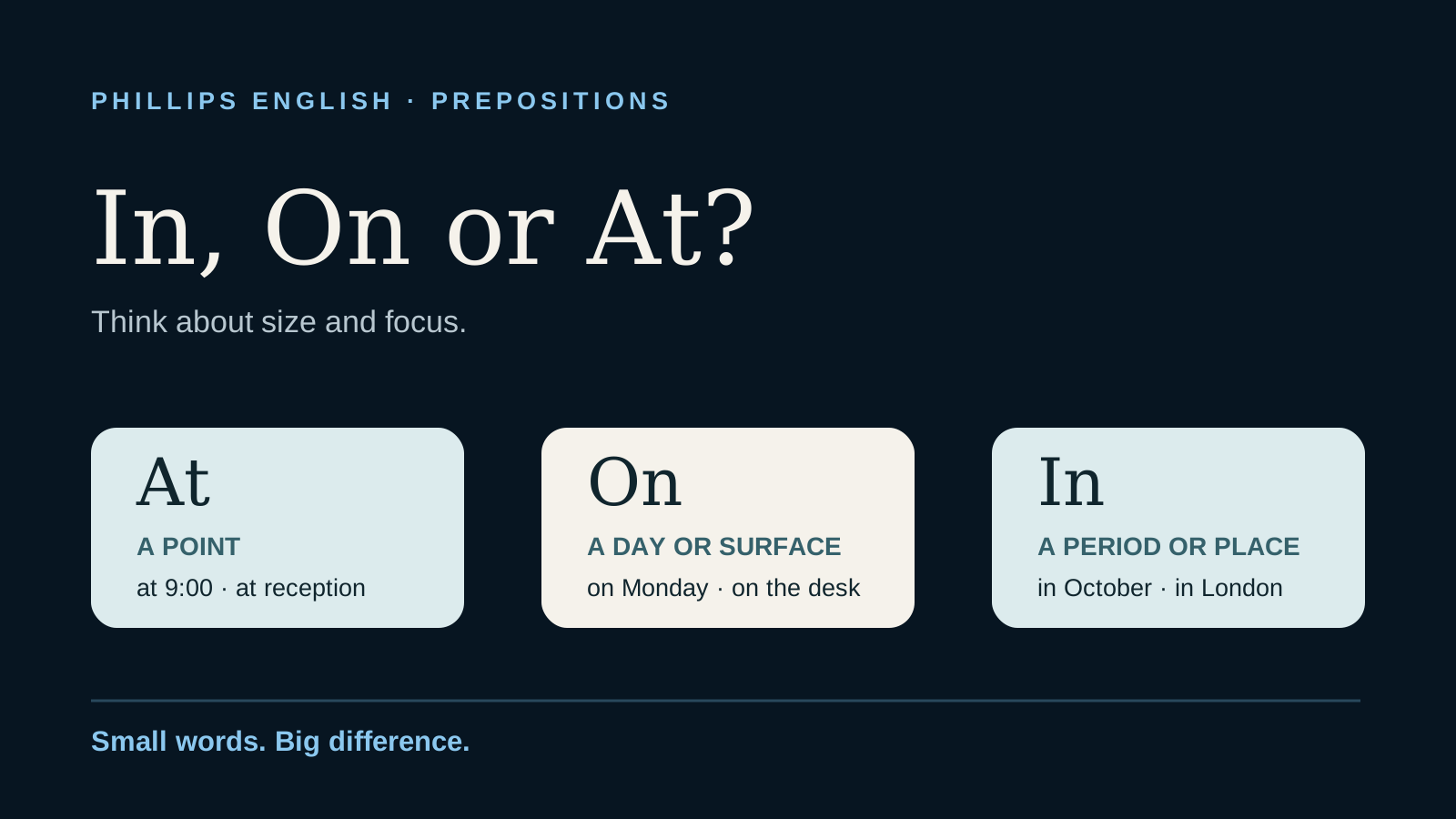
At is usually a point. On is usually a surface, day or date. In is usually an enclosed space or a longer period.
You're arranging lunch with a colleague. Do you meet in the station, on the station or at the station? And is the meeting in Monday or on Monday? These tiny words carry a surprising amount of meaning. The good news is that you don't need to memorise a hundred disconnected rules to start making better choices.
Use “at” for a point
Use at when you are thinking about one exact point in time or one specific point in a place.
at 9:00
at lunchtime
at the station
at the entrance
at work
For British English, at the weekend is also very common.
Use “on” for days, dates and surfaces
Use on with days and dates. For places, use it when something is physically on a surface or when English treats the location as a line or public transport surface.
on Monday
on 15 October
on the table
on the wall
on the bus
Use “in” for enclosed spaces and longer periods
Use in with months, years, seasons and longer periods. For places, use it when you think of the place as an area or space that contains you.
in October
in 2026
in the morning
in London
in the room
One useful contrast
I will meet you at the airport.
I am waiting in the airport.
The first sentence treats the airport as a meeting point. The second treats it as a building you are inside. Both are correct, but the idea is different.
Common mistakes
I have a meeting in Monday.
I have a meeting on Monday.
The call starts on 9:00.
The call starts at 9:00.
I was born on 1994.
I was born in 1994.
One morning, three little prepositions
“I'm meeting a colleague at the station on Monday. We'll travel on the train and arrive in London before lunch.”
Notice how naturally the words work together: at marks the meeting point, on identifies the day or form of public transport, and in places you within the city. If you're driving, you would usually say “in the car” instead. That is why examples are more useful than trying to force every expression into one universal rule.
Professional English examples
These prepositions appear constantly in schedules, emails and meetings.
The presentation starts at 10:30.
We will send the report on Friday.
The conference takes place in November.
Let us meet at reception.
The figures are shown on page 12.
Quick practice
1. The meeting is ___ Tuesday.
2. I will call you ___ 3:00.
3. We moved here ___ 2024.
4. The document is ___ my desk.
5. She is waiting ___ reception.
Answers: on, at, in, on, at.
The takeaway
Think in terms of size and focus. At is a point. On is a day, date or surface. In is a larger space or longer period. It will not explain every fixed expression in English, but it gives you a strong rule for the majority of everyday situations.
If you want corrections based on the English you actually use at work, you can try a free 25 minute lesson.