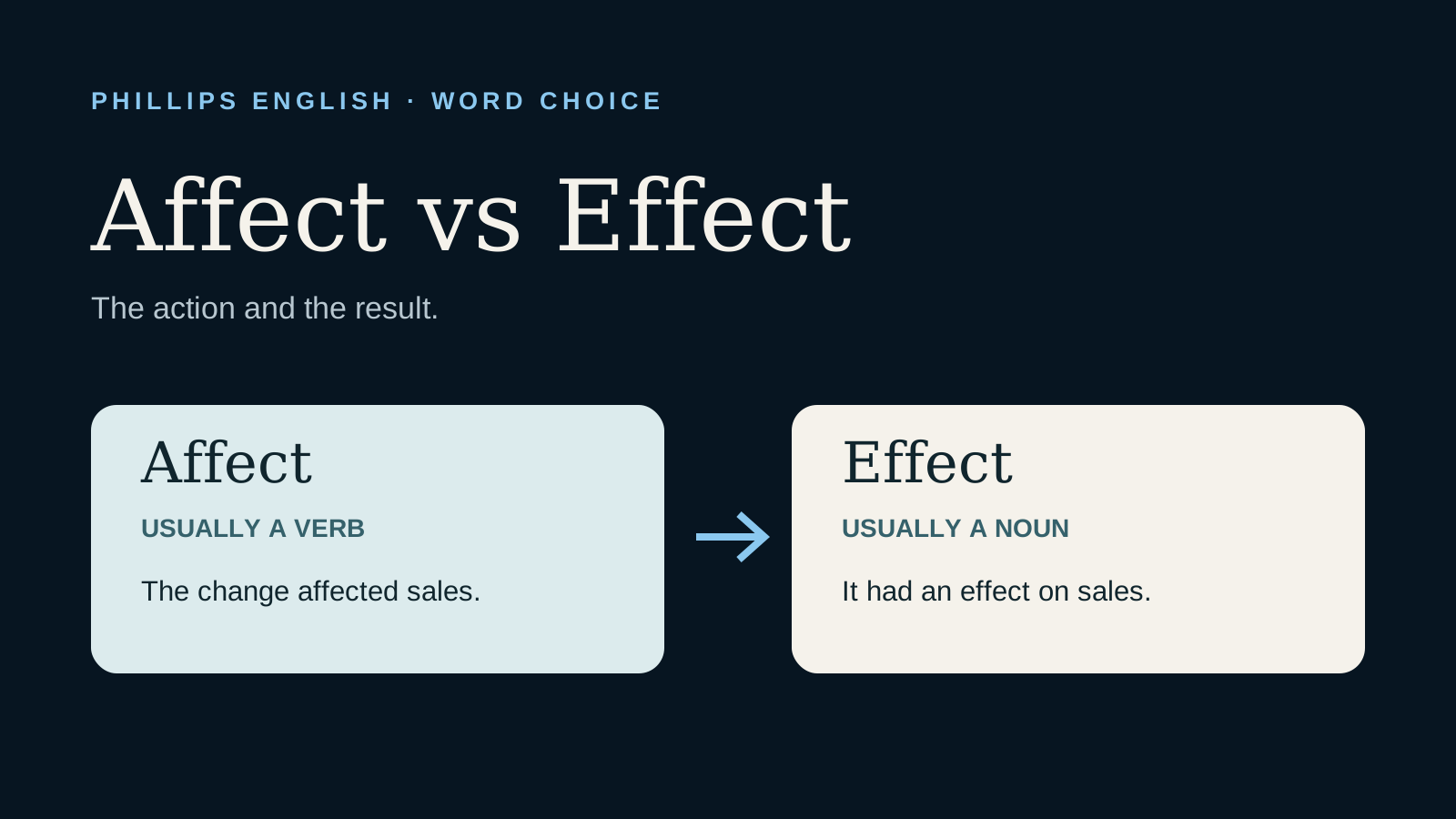
Affect is usually a verb. It means to influence or change something.
Effect is usually a noun. It means the result or consequence of a change.
A change at work has slowed everyone down. You want to explain what happened, but which sentence sounds right: “The change affected the team” or “The change had an effect on the team”? Both work. Once you understand the difference, you can switch between them without stopping to second-guess yourself.
Affect vs effect in one sentence
Here is the easiest way to see the difference:
The new policy affected productivity.
The new policy had a positive effect on productivity.
In the first sentence, affected is the action. The policy influenced productivity. In the second sentence, effect is the result of that influence.
Affect
Usually a verb.
Meaning: to influence or cause a change.
Example: The weather affected our travel plans.
Effect
Usually a noun.
Meaning: a result, consequence or change caused by something.
Example: The weather had an effect on our travel plans.
The pattern learners often miss: affect something, effect on something
This is one of the most useful parts of the rule because it helps you build the whole sentence correctly.
The decision affected sales.
The decision affected on sales.
The decision had an effect on sales.
When affect is a verb, it normally takes the object directly. We say affect sales, affect people and affect performance. We do not normally add on.
When effect is a noun, effect on is a very common pattern. We say the effect on sales, the effect on people and the effect on performance.
One problem, two ways to describe it
Imagine a new booking system has slowed your team down. Say it first with affect: “The new system has affected our response times.” Now turn the same thought into a sentence with effect: “The new system has had an effect on our response times.”
If you can switch between those patterns without changing your message, you've understood the distinction rather than simply memorised a rule.
Professional English examples
These words appear constantly in business, academic and professional communication, so learning the pattern is more useful than memorising a dictionary definition.
Higher interest rates could affect consumer spending.
The software update affected several departments.
The change had a noticeable effect on productivity.
We need to measure the effect of the campaign on customer retention.
The delay may affect the final delivery date.
A simple memory trick
Think of A for action. In most everyday situations, affect is the action. Something affects something else.
Then think of effect as the end result. You can see an effect, measure an effect or talk about the effect of something.
Effect = end result.
It is not a perfect rule for every advanced use, but it will give you the correct answer in the large majority of normal sentences.
How do you pronounce affect and effect?
The two words are easy to confuse because they sound very similar in normal speech. Both normally carry the main stress on the second syllable. The beginning of affect is typically a weak vowel sound, while effect usually begins with a short vowel sound before the stressed fect.
For learners, the bigger problem is usually not pronunciation. It is choosing the correct grammar pattern in writing. If you remember affect something and have an effect on something, you will avoid many of the most common mistakes.
Can effect be a verb?
Yes, but this is an exception and it is much more formal.
As a verb, effect means to cause something to happen or bring something about.
The new leadership team hopes to effect meaningful change.
This is not the same meaning as affect. To affect change would mean to influence the change. To effect change means to make the change happen.
Can affect be a noun?
It can, but this use is uncommon in everyday English. In psychology and some academic contexts, affect can refer to the outward expression of emotion. Most English learners do not need this meaning for normal conversation or professional writing.
For everyday English, the main rule remains the useful one: affect is usually the verb and effect is usually the noun.
Common affect and effect mistakes
The new system had a big affect on the team.
The new system had a big effect on the team.
The price increase effected demand.
The price increase affected demand.
The change affected on our results.
The change affected our results.
Quick test: affect or effect?
Choose the correct word
1. The new schedule may ______ staff morale.
2. What ______ did the training have on performance?
3. The weather has ______ attendance this week.
4. We are still measuring the long term ______ of the changes.
5. The company hopes to ______ a major change in its culture.
Answers: 1. affect, 2. effect, 3. affected, 4. effect, 5. effect.
Frequently asked questions
What is the difference between affect and effect?
Affect is usually a verb meaning to influence something. Effect is usually a noun meaning the result of that influence.
Do I say “affect on” or “effect on”?
Use effect on when effect is a noun. For example, The change had an effect on sales. When affect is a verb, use it directly with the object: The change affected sales.
Is it “affected me” or “effected me”?
In normal English, affected me is usually correct because you mean that something influenced you or had an impact on you.
What is the easiest way to remember affect vs effect?
Remember A for action. Affect is usually the action. Effect is usually the end result.
The takeaway
If you only remember one thing, remember this:
The change had an effect on the results.
Once that pair feels natural, most affect vs effect questions become much easier. The goal is not to memorise every exception at once. It is to make the most common pattern automatic.
If small mistakes like this keep appearing in your emails, meetings or presentations, that is exactly the kind of practical correction we work on in Business English coaching and pronunciation and fluency coaching.